The honest answer is that the surface decides. Torch-on bitumen membrane is still the benchmark for flat concrete slabs. Liquid rubber is better wherever the surface stops being flat: around fixings, penetrations, awkward geometry and complex detailing. Tiled roofs depend on what is under the tiles: a younger roof is repaired at its details, and an older one whose underlay has perished is usually best coated whole in liquid rubber. And on the coast, what matters most is not which membrane you choose but whether the fixings underneath it are going to corrode.
But the more useful answer is this: in Cape Town, wind-driven rain is a detailing problem, not a product problem. Understanding that will save you more money than choosing between brands ever will.
Why wind-driven rain is different
Cape Town’s winter rain does not fall on your building. It is pushed into it.
Roughly seventy percent of the year’s rain arrives between June and September, on north-westerly cold fronts, frequently with winds of fifty to sixty-five kilometres an hour behind them. That changes the physics. Vertical rain runs harmlessly over a lap, a flashing or an upstand. Horizontal rain gets driven under it.
Then the summer south-easter does something different again. It is a dry wind, so it causes no leaks directly, but it spends five months lifting sheet edges, working at poorly bonded coatings, and abrading surfaces with airborne sand. It loosens the details, and the winter fronts arrive to exploit every one of them.
So the systems that survive here are not the ones with the best datasheet. They are the ones that were detailed for water arriving sideways, at the twenty or thirty places on a roof where the waterproofing has to stop and start again.
The single most important thing we have learned since 2000
Look back through the last hundred failed roofs we have been called out to, and a pattern emerges that has almost nothing to do with the quality of the product used.
The torch-on roof failed at a lap where two sheets did not fuse. The sheeted roof failed at the fixings and the end laps. The balcony failed at the threshold and the outlet. The concrete slab failed where it met the parapet. The shower failed where the floor meets the wall.
Not one of them failed in the middle of a flat, uninterrupted surface.
Materials in the open field of a roof do their job. It is the transitions, the terminations, the changes of direction and the changes of material that let water in, because every one of those is a place where the waterproofing had to stop and start again, and every one of them relies on workmanship rather than on the product.
Which means the question “what is the best waterproofing” has a slightly uncomfortable answer: the best system is the one detailed correctly by someone who knew what the wind was going to do to it. A mid-range membrane detailed properly will outlast a premium one detailed badly, every time.
With that established, here is what genuinely belongs where.
Flat roofs and concrete slabs: torch-on
Torch-on is a bitumen-based membrane supplied in rolls, reinforced with a polyester or fibreglass carrier so it has real tensile strength rather than being bitumen alone. It is installed by melting the underside of the roll with a gas torch as it is unrolled across a prepared surface. The bitumen softens, wets out onto the substrate and cools into a bond that is chemical rather than mechanical.
The same happens at every overlap. Adjacent rolls are lapped, and the seam is torched so the two sheets fuse into a single continuous sheet. Done properly, a finished torch-on roof has no joints in the sense most people mean the word. It is one piece.
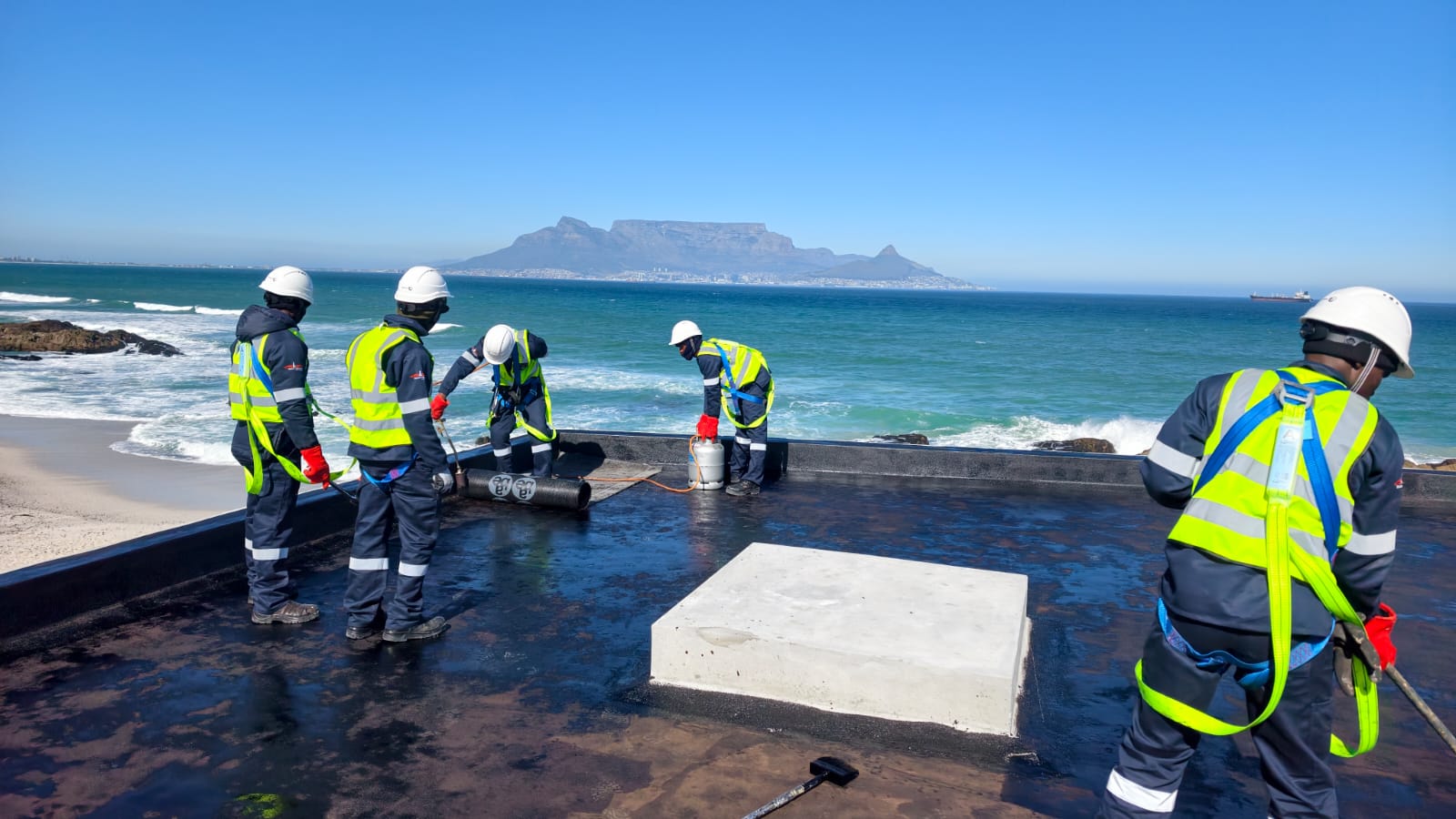
That is why it has been the benchmark for flat surfaces for decades, and why it is still what we reach for first on a concrete slab. It handles wind-driven downpours, it tolerates standing water better than most systems, and it expands and contracts through Cape Town’s temperature swings without tearing.
Where it fails is at the edges. Specifically:
- At the laps, where two sheets were meant to fuse and instead were pressed together after one had already cooled. That seam looks perfect. It is not bonded. Under two winters of driven rain, the difference shows.
- At the upstands, where the membrane turns up a parapet or wall. That turn-up needs enough height to beat wind-driven water, which is the detail Cape Town punishes hardest, and it has to be properly terminated at the top so water cannot run down behind it. A membrane that stops flat at the base of a wall, or turns up two centimetres because that is what the offcut allowed, will let water in behind the entire system.
- At the outlets, where the membrane has to dress down into a drain.
So when you are comparing torch-on quotes, the meaningful questions are about upstand heights, lap treatment and outlet detailing, not about the brand on the roll.
Complex roofs, fixings and awkward shapes: liquid rubber
Liquid rubber goes on wet, by brush, roller or spray, and cures into a single continuous skin. There is no seam anywhere in it, because there was never a second piece.
That matters enormously in Cape Town, for two reasons.
It removes the joint problem entirely. If almost every failure is at a joint, a system with no joints in it is answering the actual question.
It goes over geometry a sheet cannot. A sheet membrane is a flat product. Anywhere the surface stops being flat, the sheet has to be cut, folded, overlapped or terminated, and each of those is a workmanship detail. Around a screw head, there is no way to fold a sheet at all.
Liquid rubber does not care about shape. Around a fixing on a sheeted roof, it flows around the head and seals the washer line into one piece, encapsulating the fixing rather than covering it. Along a rib profile, it follows the profile. Into an outlet, it dresses down and terminates continuously. Up an upstand and over a coping, it turns the corner in one pass.
For a coastal roof, that encapsulation is the single most valuable property available, and we will come back to why.
Tiled roofs: the underlay decides
This is the biggest takeaway in this article, because it is where we see the most money wasted, in both directions.
A tiled roof is not one layer. The tiles shed most of the water down their overlaps, but in a Cape Town front some rain is always driven in between them. Under the tiles is a plastic underlay that catches that water and carries it down to the gutter. On a windy winter night, the underlay is what actually keeps your ceiling dry.
That underlay does not last. Heat in the roof space and sunlight through the gaps break it down, and after about twenty years it is brittle, torn or gone. From the street the roof looks exactly as it did. In practice the tiles are now the only thing between a cold front and your ceiling, and they were never designed to do that job alone. That is why an older roof can stay dry in ordinary rain and leak in every front. By that age, concrete tiles have often started losing their dense surface too, and absorb water rather than shed it.
Once the underlay has gone, there are two real fixes. One is to lift every tile, lay new underlay and relay the roof, which is a re-roofing job priced like one. The other is to coat the whole roof in liquid rubber, so the tiles and every overlap between them become one continuous membrane with nothing for driven rain to get under. On most older roofs, liquid rubber is the better answer. It is considerably cheaper and far less disruptive, and it deals with the entire roof at once instead of chasing leaks one front at a time.
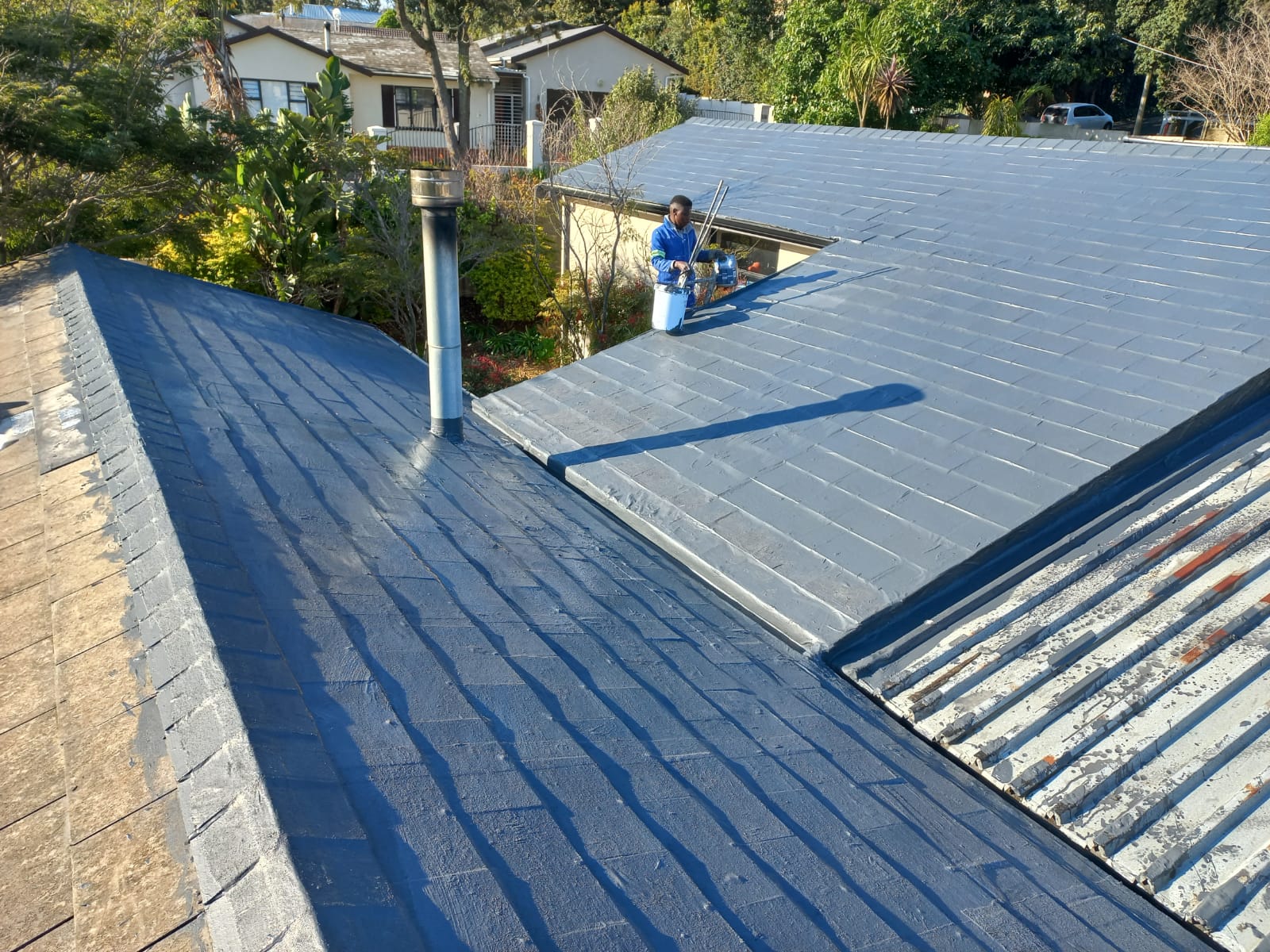
The order matters. Broken tiles are replaced, ridges re-bedded, valleys and flashings sorted and the roof properly cleaned first. The coating goes on last, over a sound roof.
A younger roof is a different job. If the underlay is still intact and the roof leaks in one place, the leak is at a detail: a ridge, a valley, a flashing, a penetration or a cracked tile. Coating the whole roof leaves that detail leaking under the new surface. Fix the detail.
So the question is not “should my tiled roof be coated?” but “what state is the underlay in?” We check it from inside the roof space on every tiled roof inspection, and we will tell you plainly which roof you have.
Metal and sheeted roofs, especially near the coast
On a sheeted roof, whether IBR, corrugated or Chromadek, the sheet itself is usually not the problem. The fixings are.
Every fixing is a hole punched through the waterproof plane, sealed with a washer that has a shorter life than the sheet does. UV and heat cycling perish the washers. The south-easter works at the edges. And in the coastal corridor, through Table View, Milnerton, Bloubergstrand and the Atlantic Seaboard, continuous salt-laden air corrodes fixings, gutters and sheeting years faster than it happens inland. The same roof in Brackenfell will outlast it comfortably.
So a coastal sheeted roof is a roof with a hundred small future leaks in it, on a timer.
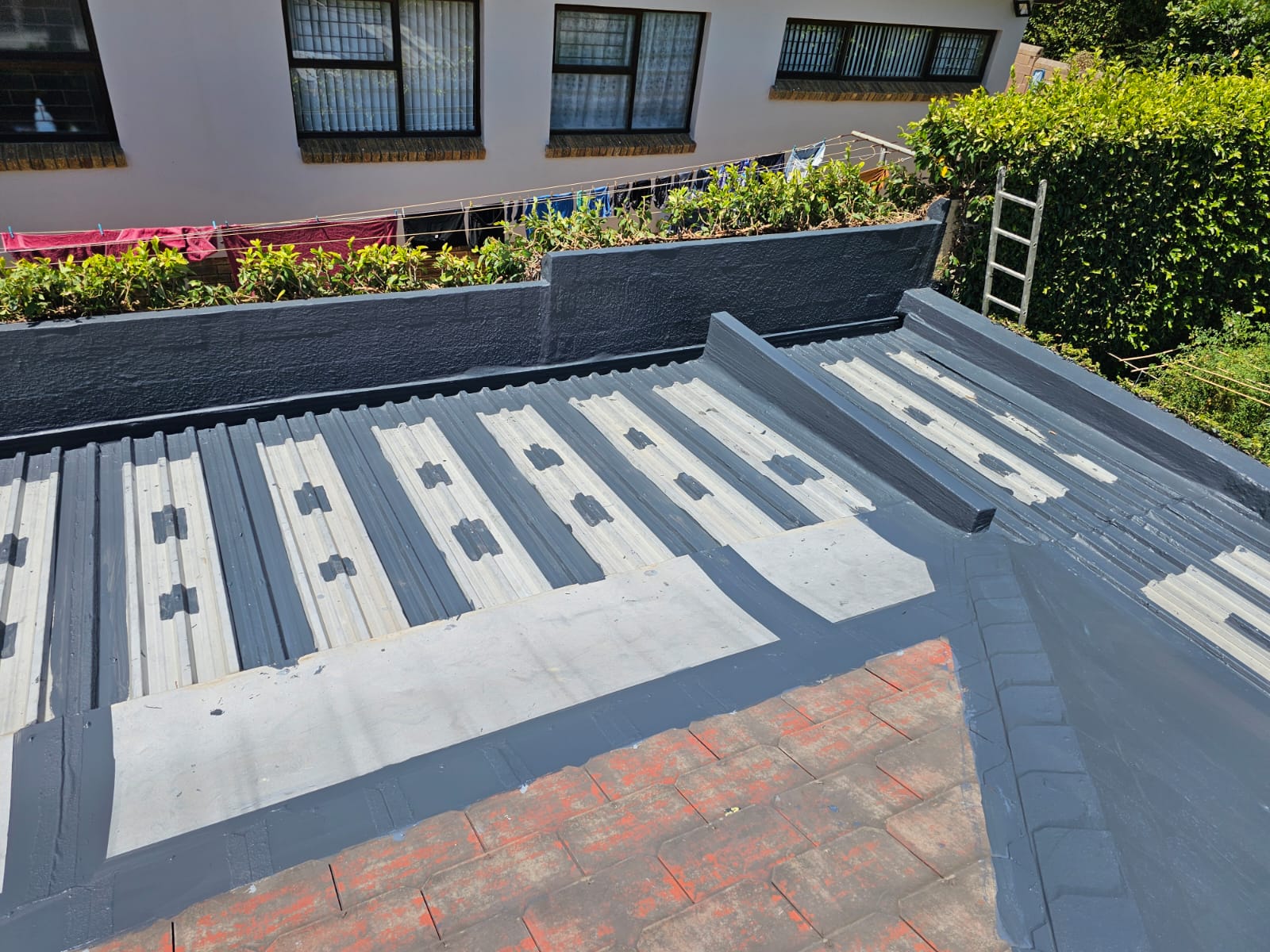
This is where liquid rubber earns its keep. Encapsulating each fixing head and washer line into a continuous membrane addresses the actual failure mode rather than painting over it. It also follows the rib profile and seals the end laps in the same pass.
Walls, parapets and flashings
Vertical surfaces are a different problem again, because water is being driven at them rather than sitting on them.
Standard exterior paint is not a waterproofing system and does not pretend to be. It has no meaningful ability to bridge a crack, and hairline cracking from building movement and wind buffeting is exactly how wind-driven water gets into a wall.
What works on walls and parapets is a flexible, elastomeric system with real elongation, one that stretches over fine cracks instead of splitting along them, over a properly prepared surface. Parapets deserve particular attention, because they take wind-driven rain on both faces and are where a lot of flat-roof leaks actually originate.
One warning worth repeating. Never apply a waterproof coating to the inside face of a wall that is actively taking on water. It does not stop the water. It traps it, softens the plaster from behind, and turns a repair into a replastering job.
Coastal versus inland: what actually changes
| Coastal corridor | Inland northern suburbs | |
|---|---|---|
| Main threat | Salt corrosion of fixings, gutters and sheeting; constant moisture | Heavy clay soil holding water against foundations; UV and heat cycling |
| What fails first | Fixings, washers, gutters, exposed metal | Underlay on older tiled roofs; damp courses bridged by raised paving |
| What we specify | Systems that encapsulate fixings and tolerate salt air; salt-resistant topcoats | Detailing at ridges, valleys and flashings; drainage checked before anything is coated |
| Realistic lifespan | Shorter. Plan maintenance cycles accordingly | Longer, given the same system and the same standard of application |
What heat-reflective coatings do and do not do
Heat-reflective coatings such as Insulcoat come up often, so it is worth being straight about them.
They reduce roof surface temperature and can make a meaningful difference to how hot the rooms below get, which can reduce cooling costs. That is a real benefit, and on the right building it is worth the money.
What they are not is a substitute for a waterproofing system. A reflective coating on a roof that has a detailing problem is a cooler roof that still leaks. Deal with the water first. Then decide about the heat.
The question to ask any contractor
If you take one thing from this article into your next three quotes, make it this:
“Show me on the roof where you think the water is getting in, and tell me how you are going to detail that specific point.”
A contractor who answers that clearly, pointing at the lap, the upstand, the outlet, the flashing or the fixing, is quoting for your roof. A contractor who answers with a product name and a price per square metre is quoting for any roof.
That is why we inspect before we quote, why we price preparation separately from the waterproofing on every written quote, and why on a tiled roof we go into the roof space and check the underlay before we tell you whether it needs a repair or a coating. Site inspections are free anywhere in the metro, with no call-out fee, and the work carries a written minimum two-year guarantee.
Call us and tell us your suburb, your roof type, and where you are seeing water.